In August 2008, the US Congress approved without any major discussion the Pentagon budget for the following 12 months a budget totaling $700 billion. US joint expenditure for Iraq and Afghanistan amount to about $12 billion per month. A month later, in September, the Federal Reserve and the US Treasury succeeded in committing another $700 billion of taxpayers' money to save Wall Street from a financial meltdown. The new president will take office with $1.5 trillion already committed by his predecessor. This is money he does not control, money that will be insufficient to win a war in Iraq and Afghanistan and save the world economy. These budgets will have to be increased.
The war will take priority over social reforms, because money is scarce and the US is running a $10 trillion deficit, which means that 70% of what will be produced in 2009 has already been spent. Obama has a few choices;
Increase the debt hoping that the world in recession will continue to subscribe to US treasury bonds that have virtually no yield and
Print money, worrying about inflation later;
Drastically reduce social programs and
Fail to meet expectations a la Clinton "sorry providing health care to everybody is a dream, so we carry on as usual," a move which will make him very unpopular. At the time of Clinton the economy was expanding and his excuse was expected, now it is contracting.
Or President Obama could drastically cut military expenditure, bring the troops back home and focus on healing the country from the social holocaust of the Bush years.
Change will come only if this last option is be embraced. Change for a politician can mean many things, big changes, small changes, cosmetic changes. The change Obama promised is the real thing, a great transformation. Let's hope he has the courage to transform his magic words into facts.
Saudi King Abdullah bin Abdul Aziz (R) welcomes British Prime Minister Gordon Brown.
November 3, 2008 (LPAC)--Under this title the leading Saudi international daily Asharq Al-Awsat posted a comment by Hussein Askary on November 3 under the report of British Prime Minister Gordon Brown's visit to Saudi Arabia, Qatar and the UAE to force them to back the "Britain Woods" dictatorship of the IMF.
In the 170-word-limited space for commentaries on the report, which was the main story in Asharq Al-Awsat, Askary wrote: "Don't support the British Empire!Anyone who harbors the illusion that America is the sole controller of the world and that it is the power which dictates to the Arab states their policies, should carefully study what Brown is doing. He is trying to save the international financial system which is controlled by the hedge funds based in the British islands, such as the Cayman Islands, through the creation of a world government under the umbrella of the IMF and run by Britain. This would supposedly be financed by the money from the Arabs which is not enough, and will never be enough to save the global financial system which was declared dead by Lyndon LaRouche a year ago. The British Empire is not a nation. It is not England. It is a group of financial and economic interests that need nations and armies to impose their control over all nations."
The publishing of this comment, although carefully reviewed, because it took hours to be posted, does not imply that the Saudis are saying "No" to the demands by Brown to pump money into the IMF. The Saudis have not said anything, but Brown, who was in Qatar on Sunday Nov. 2, after meeting the Saudi officials on Saturday, said that he was confident the Saudis will help the IMF.
To make sure that the Arabs get the point, Brown took with him the CEOs of BAE, Rolls Royce, and British Petroleum of the Al-Yamamah affair fame, among others . The BAE-Prince Bandar Al-Yamamah operations to support and manipulate international terrorism is also capable of reaching inside the palaces and bedrooms of the kings and Sheikhs of the region. So far, one Saudi king has been murdered in his own palace. A few weeks ago, the successors of the former King Faisal bin Abdul-Aziz inaugurated a museum celebrating his life on the occasion of his assassination at the hands of a young member of the royal family in 1975 following the oil crisis of 1973. The assassin was studying in the U.S., and reportedly part of the MK-Ultra project.
One interesting irony is that Brown arrived to the region on November 2, the 91st anniversary of the Balfour Declaration, part of the Sykes-Picot plan, which promised the Jews of Europe a homeland in Palestine (see letter above, inked by James Balfour to Lord Rothchild, a leader of the British Jewish community, for transmission to the Zionist Federation, a private Zionist organization ). Since then, Southwest Asia has been a bloody cockpit of British geopolitics and destabilization, and the Jews of Israel have not enjoyed peace in the new homeland, exactly due to British policies.
Readers have been pressing for a solution to the financial crisis. But first it is necessary to understand the problem. Here is the problem as I see it. If my diagnosis is correct, the solution below might be appropriate.
Let's begin with the fact that the financial crisis is more or less worldwide. The mechanism that spread the American-made financial crisis abroad was the massive US trade deficit. Every year the countries with which the US has trade deficits end up in the aggregate with hundreds of billions of dollars.
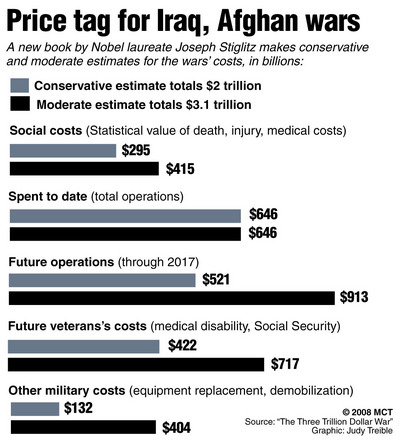
Nobel prize winning economist Joseph Stiglitz predicts the Iraq war will cost the United States $3 trillion. Nouriel Roubini, the economist who predicted today’s financial crisis in 2006, predicts the U.S. will suffer its worst recession in 40 years, lasting up to two years with 9% unemployment and another 15% drop in housing prices. He predicts we are seeing only the first round of government injection of funds into the finance system.
Throughout the Iraq war and occupation peace activists have pointed to the cost of war as one reason why the occupation must end. The “cost of war” clock is almost universal on anti-war sites. But now, with reports that the $1.8 trillion spent on bailing out the U.S. finance system is not enough to save the U.S. economy, the cost of war and the military budget must be reconsidered. The U.S. will need to choose – continued occupation or creating a new economy.
Unlike the depression which ended in part because of World War II, this time military spending is contributing to economic demise. Military spending takes money from the rest of the economy and prevents a federal budget that invests in re-tooling the economy. Spending hundreds of billions on the Iraq and Afghanistan war, and hundreds of billions more annually on military spending is one reason why the U.S. economy is faltering. The DoD is expected to put forward an even bigger budget request before the next president takes office. This will force the next president to quickly confront whether the military continues to dominate U.S. foreign policy and the U.S. budget.
Three of the most important functions of free markets are: price discovery, the provision of liquidity, and capital allocation. Honest and transparent dealings between willing buyers and sellers are thought to result in liquid and efficient marketplaces. Prices are determined, second by second, in a process of public negotiation, taking old and emergent information about risks and returns into account. Capital is allocated to the highest bidder, who, presumably, can make the most profit on it. And every seller finds a buyer and vice versa.
The current global crisis is not only about the failure of a few investment banks (in the USA) and retail banks (in Europe). The very concept of free markets seems to have gone bankrupt. This was implicitly acknowledged by governments as they rushed to nationalize banks and entire financial systems.
In the last 14 months, markets repeatedly failed to price assets correctly. From commodities to stocks, from derivatives to houses, and from currencies to art prices gyrate erratically and irrationally all over the charts. The markets are helpless and profoundly dysfunctional: no one seems to know what is the "correct" price for oil, shares, housing, gold, or anything else for that matter. Disagreements between buyers and sellers regarding the "right" prices are so unbridgeable and so frequent that price volatility (as measured, for instance, by the VIX index) has increased to an all time high. Speculators have benefited from unprecedented opportunities for arbitrage. Mathematical-economic models of risk, diversification, portfolio management and insurance have proven to be useless.
Inevitably, liquidity has dried up. Entire markets vanished literally overnight: collateralized debt obligations and swaps (CDOs and CDSs), munis (municipal bonds), commercial paper, mortgage derivatives, interbank lending. Attempts by central banks to inject liquidity into a moribund system have largely floundered and proved futile.
Finally, markets have consistently failed to allocate capital efficiently and to put it to the most-profitable use. In the last decade or so, business firms (mainly in the USA) have destroyed more economic value than they have created. This net destruction of assets, both tangible and intangible, retarded wealth formation. In some respects, the West - and especially the United States - are poorer now than they were in 1988. This monumental waste of capital was a result of the policies of free and easy money adopted by the world's central banks since 2001. Easy come, easy go, I guess.
Driving all of this is the global casino known as the derivatives markets, a market which dwarfs the world's mortgage, bond and the stock markets, combined. While mortgages, stocks and bonds are measured in the trillions of dollars, the derivatives market is measured in quadrillions, or thousands of trillions of dollars. Putting a number to the size of the derivatives market is virtually impossible, but putting a number to the value of the derivatives market is easy--zero!
Derivatives were the great financial innovation of the Greenspan era, in which casino-style bets on the price movements of currencies, bonds and stocks replaced the ownership of those items as a way to make money. The bets thus placed soon far outstripped the levels of the markets upon which they were nominally based, as derivatives became the prime source of "profit" for the financial markets. That these "profits" were entirely fictitious, a fancy form of casino-floor betting chips, was considered irrelevant as long as the market was growing and the funny money was pouring in. Last summer, however, the financial system died, sealing the doom of the derivatives game.
Today, the collapse of the derivatives market is crushing the international financial system, as the speculators fight to save the fictitious "profits" through the largest bailout attempt in history. We stress attempt, because the bailout is not working, and can not work--there isn't enough money in the world to cover all these funny-money bets, and the efforts by the central banks to print that money, is fuelling a hyperinflationary bomb which will wipe out not only the remnants of financial system, but also the governments, national economies and the means of existence for most of the world's population. Hyperinflation will destroy the value of the dollar itself, wiping out pensions, savings, bank accounts, stock portfolios, and all other monetary values, bankrupting households, businesses and governments, leaving the nation destroyed, and, effectively, no longer a nation. We have barely scratched the surface of the horrors that will come, if we continue down this path.
The US stock market has dropped 2500 points in 9 days. Trillions of dollars in wealth disappeared as the Dow lost six years worth of growth. The Bush administration and Congress have tossed ever increasing amounts of money at failing firms, hoping to appease the economic gods, rather as the ancient Canaanites sacrificed children to Baal. But the markets refuse to be appeased, and financial contagion has circled the globe. Twelve more days like that and it hits zero.
Even before the economic crisis spiraled out of control, the US government was effectively broke. The national debt currently stands at $9.8 trillion, up $4 trillion (about 72 percent) since George W. Bush took office. With the pre-bail-out federal deficit in 2009 expected to hit a half trillion dollars, earlier this year Congress upped the debt ceiling to $10.6 trillion. But truly frightening are the many liabilities yet to come due. Uncle Sam is an extraordinary wastral and soft touch, like the person who cosigns notes for relatives, buys rounds of drinks for his friends, and promises everyone he knows that he'll take care of them.
The federal government makes loans and loan guarantees for most any purpose known to man or woman – education, energy research, housing, agricultural land, airlines, veterans, and more. The Federal Deposit Insurance Corporation is billions of dollars short of the reserves necessary to cover expected bank losses. Washington is on the hook for generous pensions for its own workers as well as billions of dollars in guarantees of pensions for private workers whose companies fail. Then there's Medicare and Social Security, which together have an unfunded liability – that is, promised benefits exceeding expected revenues – of more than $100 trillion. No one knows where the money is going to come from to pay all of these bills, but that hasn't stopped Congress from continuing to expand benefits. In 2003 the Republican Congress and Republican president created the Medicare drug benefit without bothering to figure out how to pay for it, adding trillions of dollars more to the system's unfunded liabilities.
Now the government's liabilities are going up again, as Congress and the administration spend wildly in an attempt to revitalize the economy. Indeed, the administration and Congress apparently are prepared to bankrupt America to save American business. So far this year they have spent: $850 billion for the Wall Street bailout plus the financial "sweeteners" needed to buy enough votes for passage; $300 billion to bail out the housing industry largely through the Federal Housing Administration; $200 billion in Federal Reserve loans to commercial banks; $200 billion (and probably more) to bail out and essentially nationalize the political piggy banks Fannie Mae and Freddie Mac; $144 billion or more to buy mortgage-backed securities through Fannie and Freddie (yes, the same entities being bailed out by Uncle Sam because of their past purchases of bad debt); $87 billion to repay JPMorgan Chase for financing Lehman Brothers trades; $85 billion for a loan to bail out and effectively nationalize insurer American International Group; $50 billion to guarantee money market funds; $37.8 billion in a second loan to AIG, $29 billion to finance the buyout of Bear Stearns; $25 billion in loans to the auto industry, which continues to sink as demand for cars falls; $10 billion in direct Treasury Department purchases of mortgage-backed securities; $4 billion in mortgage community grants.
1) How did the senseless Iraq war bankrupt our country and has this ever happened before in history? Historians know that arms races and senseless wars bankrupted Athens, Rome, Spain, France and untold other empires that later fell apart. The French Revolution was partly the result of the bankruptcy of France under those two spendthrift kings, Louis XV and Louis XVI. Drained by an arms race with England, the French treasury was empty and the French kings were deep in debt. Unfortunately, a disastrous harvest made bread too expensive for all but aristocrats. Though Marie Antoinette did not say, Let 'em eat cake (brioche, technically) she lost her head anyway. No wonder the Bushies are moving battalions home from Iraq. They expect civil chaos after they try to steal the next election. I hope to be in Venice watching the water rise.
2) How many civilians died in Iraq? We hear a lot about the four thousand women and men who died wearing US uniforms. My heart goes out to them and their parents, children and spouses--but they were (mostly) volunteers. Of course this does not make their loss any less horrific, any less tragic, any less wasteful. But the dead Iraqi civilians volunteered for nothing. Many were children too young to volunteer for anything but flying kites or toddling about. Many were mothers who could not protect them. Many were fathers who had no secular divisions to fight, who were merchants or farmers or artisans or teachers. Why does nobody ever mention them? Their numbers are in the hundreds of thousands, possibly millions. Nobody counts. They are the unsung victims of our useless, treasury-draining war.
3) Why do we persevere in torturing people though it doesn't result in real information and makes us hated all over the world? John McCain was tortured but appears to gave forgotten. When a country prates of democracy and "being the greatest in the world," it does not inspire confidence when we flout all our best traditions. We broke our rules of engagement, abandoned the Geneva Conventions. Is it a surprise nobody believes us any more?
4) How come nobody asks: What's the role of insurance companies and pharmaceutical companies in harming our health care? We pay more for care than any other western country. The costs hurt our health, our businesses' global competitiveness and most of all our kids. Why is this the elephant in the room? Why do drug companies advertise that they will give you free pills--if you're destitute. Why don't they just charge fair prices? Why doesn't our government make them? Why do the insurance companies act like our de facto government?
5) WHY DOES NOBODY MENTION THE STOLEN ELECTIONS OF 2000 and 2004? The Rovians are at it again--fixing touch screen machines, hacking into servers and the so-called mainstream media is not reporting it. Why are the Democrats not fighting back? The Repugnicans are slandering them with voter fraud. The best defense is an offense, they figure. Why does no one bring it up?
Are you listening, Tom Brokaw, Gwen Infill, Bob Schieffer, Katie Couric, Brian Williams, Charlie Gibson? Is anybody there?
6) And finally, what is the role of the mainstream media in keeping the truth from us? Can media owned by Rupert Murdoch, General Electric and other war-mongers, tell us the truth about the war profiteers who are getting rich while we are getting poor? Why should they? Will Cheney blow the whistle on Halliburton?
"Some people think that the Federal Reserve Banks are United States Government institutions. They are private monopolies which prey upon the people of these United States for the benefit of themselves and their foreign customers; foreign and domestic speculators and swindlers; and rich and predatory money lenders." – The Honorable Louis McFadden, Chairman of the House Banking and Currency Committee in the 1930s
The Fed’s website insists that it is not a private corporation, is not operated for profit, and is not funded by Congress. But is that true? The Federal Reserve was set up in 1913 as a "lender of last resort" to backstop bank runs, following a particularly bad bank panic in 1907. The Fed’s mandate was then and continues to be to keep the private banking system intact; and that means keeping intact the system’s most valuable asset, a monopoly on creating the national money supply. Except for coins, every dollar in circulation is now created privately as a debt to the Federal Reserve or the banking system it heads.
So let’s review:
1. The Fed is privately owned.
Its shareholders are private banks. In fact, 100% of its shareholders are private banks. None of its stock is owned by the government.
2. The fact that the Fed does not get "appropriations" from Congress basically means that it gets its money from Congress without congressional approval, by engaging in "open market operations."
Here is how it works: When the government is short of funds, the Treasury issues bonds and delivers them to bond dealers, which auction them off. When the Fed wants to "expand the money supply" (create money), it steps in and buys bonds from these dealers with newly-issued dollars acquired by the Fed for the cost of writing them into an account on a computer screen. These maneuvers are called "open market operations" because the Fed buys the bonds on the "open market" from the bond dealers. The bonds then become the "reserves" that the banking establishment uses to back its loans. In another bit of sleight of hand known as "fractional reserve" lending, the same reserves are lent many times over, further expanding the money supply, generating interest for the banks with each loan. It was this money-creating process that prompted Wright Patman, Chairman of the House Banking and Currency Committee in the 1960s, to call the Federal Reserve "a total money-making machine." He wrote:
"When the Federal Reserve writes a check for a government bond it does exactly what any bank does, it creates money, it created money purely and simply by writing a check."
3. The Fed generates profits for its shareholders.
The interest on bonds acquired with its newly-issued Federal Reserve Notes pays the Fed’s operating expenses plus a guaranteed 6% return to its banker shareholders. A mere 6% a year may not be considered a profit in the world of Wall Street high finance, but most businesses that manage to cover all their expenses and give their shareholders a guaranteed 6% return are considered "for profit" corporations.
In addition to this guaranteed 6%, the banks will now be getting interest from the taxpayers on their "reserves." The basic reserve requirement set by the Federal Reserve is 10%. The website of the Federal Reserve Bank of New York explains that as money is redeposited and relent throughout the banking system, this 10% held in "reserve" can be fanned into ten times that sum in loans; that is, $10,000 in reserves becomes $100,000 in loans. Federal Reserve Statistical Release H.8 puts the total "loans and leases in bank credit" as of September 24, 2008 at $7,049 billion. Ten percent of that is $700 billion. That means we the taxpayers will be paying interest to the banks on at least $700 billion annually – this so that the banks can retain the reserves to accumulate interest on ten times that sum in loans.
The banks earn these returns from the taxpayers for the privilege of having the banks’ interests protected by an all-powerful independent private central bank, even when those interests may be opposed to the taxpayers’ -- for example, when the banks use their special status as private money creators to fund speculative derivative schemes that threaten to collapse the U.S. economy. Among other special benefits, banks and other financial institutions (but not other corporations) can borrow at the low Fed funds rate of about 2%. They can then turn around and put this money into 30-year Treasury bonds at 4.5%, earning an immediate 2.5% from the taxpayers, just by virtue of their position as favored banks. A long list of banks (but not other corporations) is also now protected from the short selling that can crash the price of other stocks.
Read further Ellen Brown article here. Ellen Brown, J.D., developed her research skills as an attorney practicing civil litigation in Los Angeles. In Web of Debt, her latest book, she turns those skills to an analysis of the Federal Reserve and "the money trust." She shows how this private cartel has usurped the power to create money from the people themselves, and how we the people can get it back. Her eleven books include the bestselling Nature’s Pharmacy, co-authored with Dr. Lynne Walker, and Forbidden Medicine. Her websites are www.webofdebt.com and www.ellenbrown.com .
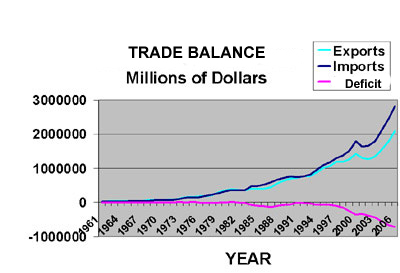
The credit crunch, failures of sub-prime loans, and bank bailouts are manifestations of the real problem. And what is the major problem? It is the trade deficit, which siphoned money out of the country and dictated an uncontrolled credit expansion to finance domestic spending. The trade deficit continues, but the credit expansion has reached its end. Two graphs tell the story.
The first graph describes the trade balance of payments and shows the resulting deficit, which has grown steadily since the mid-1980s (except during the 1991 and 2002 recessions) and rapidly since the late 1990s. The present $900B trade deficit is still rising and cannot be easily contained. With manufacture of basic goods, such as clothing, electronics and plastics having been shifted to developing nations, the U.S. consumer presently has no alternative and must purchase these imported goods from external suppliers. Add a dependence upon imports for crude petroleum, steel mill products and refinery products and also the excessive consumption of imported raw materials and automobiles and we learn that the totality of reliance upon imports severely limits the domestic income and funds that are available for spending on domestic production.
To compensate for the lack of domestic savings, the U.S. economy opened its gates to foreign savings. Foreign investment and purchase of U.S. Treasuries served to re-circulate dollars, which relieved the pressure on the dollar, and financed purchases of imports and domestic production. These mechanisms are only partial solutions to low domestic savings and cannot continue forever. The investments and their profits must be repaid and this is now happening. The Balance Of Payments Account can no longer be supported by foreign savings and investment, which means the U.S. has no supports for the flight of its jobs and capital.
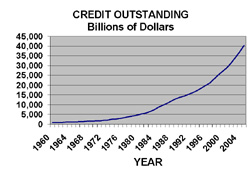
The shift of capital and manufacturing to the low wage nations has shifted purchasing power to the workers of these nations and decreased the purchasing potential of American workers. Maintainability of this shift is possible if the U.S. runs a positive balance of trade and foreigners purchase more U.S. goods and services. This has not been the case. Instead a continuous credit expansion has been used to finance an unsustainable trade deficit and the sales of domestic production. The next figure describes the credit expansion.
The Credit Outstanding curve shows steady growth since 1970 and accelerates rapidly after 1998, coincident with the time the trade deficit increased rapidly. Debt has obviously been used to finance imports and domestic consumption by substituting credit for the lack of internal purchasing power. The total debt, which consists of government, consumer, corporate and all other financial debt instruments reached $40T in 2004 and is now about $50T.
Federal government deficits, which have become unwieldy, financed a part of U.S. growth. Credit did the rest; fueling the seemingly perpetual motion economy of continuous growth. Theory predicted, as for all perpetual motion machines, it would soon grind to a halt. Adhering to the principle that “a rolling loan gathers no loss,” and utilizing artificially maintained low interest rates, creative financing, credit card expansion and finally sub-prime mortgages for the last batch of available spenders, system financiers increased the money supply and enabled purchasing power, especially for the home construction industry.
Free money, rather than free enterprise, more accurately characterized the U.S. economic system, which has been hit by a four times whammy: (1) Credit markets have reached their limit, (2) Foreign investment can no longer finance the trade deficit, (3) The federal debt seems too high to support adequate fiscal stimulus plans, and (4) A sizeable number of debtors cannot repay loans.
Whether foreign capital is “pushed” or “pulled” into a country has important implications. Money that is pulled into a country does so because its investments are attractive. Money that is pushed into a country does so for a variety of factors extraneous to the host country. In this case the host country, the US, is getting money not because of the investment opportunities it provides but rather because foreign countries want to stimulate Americans to buy their goods. History shows that money pushed into a country can lead to financial bubbles and borrowing binges in the host country as it must readjust to the inflow. Think of it like giving your college age child large sums of money each week.
Economists may argue over whether money has been pushed or pulled into the US. There is no arguing that starting in the early 1980’s when the Reagan administration began dismantling regulations that foreign central banks started aggressively buying US treasuries($2.7 trillion held in the Fed’s custody account alone and does reflect Eurodollars, bank deposits, Foreign exchange swaps, Eurobonds, etc. held). We have consistently adjusted to this inflow by running record trade and current account deficits, ones that have historically brought calamity. Former Federal Reserve Chairman Greenspan remarked over four years ago how America’s ability to run deficits had gone well beyond historical norms. We have not been forced to pay the piper yet because foreign governments continue to “push” money into the US to maintain growth of their economies at our expense.
This massive inflow of capital (dollar purchases) over the last two decades has not caused a surge in our economic growth which has chugged along at only a modest rate. It has led to a host of speculative bubbles beginning with the 1987 stock market bubble and the innumerable crashes and ensuing bailouts that followed. It has also led to a borrowing binge by US consumers who are now saddled with massive debt($2.6 trillion). In other words, all this money flowing into the US has not led to a commensurate surge in US growth but has significantly deteriorated our country’s and citizen’s balance sheet and made us vulnerable. Within a few decades we have gone from being the world’s largest creditor to being its largest debtor.
The long term consequence of letting a country continue to “push” money into a host country can be devastating. China, for example, has consistently intervened in foreign exchange markets by buying dollar denominated bonds and paying for it by selling its own currency to keep its value low and prop up the dollar (“push” money in). By letting the Chinese and others keep the value of the dollar artificially high and their currency value low, US exports have been made non-competitive in foreign markets. This has prevented us from exporting our way out of our trade deficit which is the mechanism by which trade imbalances are corrected. Over time this has meant the gutting of US exporting industries and a significant loss of jobs.
Some have wondered if GW Bush knows what he's doing with his tax cut that benefits the corporations and the very rich, and cuts away the remaining money of the poor and the middle class. I say yes, he does know what he'd up to, as do his corporate advisors and his neo-con economist friends and theorists, chief among them Grover Norquist. Norquist has been the chief architect behind the dismantling of the American federal financial structure in terms of benefits for the common citizen, but has helped to create the superstructure of tax breaks for the very rich and the corporatocracy that now has a choke-hold on America.
The plan is very simple, but not obvious on first blush. Make sure that all the money is gone from the U.S. treasury, make sure the deficits are so great that all social and educational programs are cut, increase the military and security budgets to "protect our nation" with all these monies going to corporations and security firms who are extra-national (not tied to any country, but actually more than multi-national in that they are outside the purview of any nation at any single moment) and stave in the social security fund by allowing it to go to private corporations for "investment"-and you have the perfect scenario for saying, "only the private sector can save us-we're broke and they have the money to run every program, fund every program, but of course, at huge costs and profits for the private corporations." Our only resource will be the corporate lenders, especially the large extra-national corporations who will have loyalty to no one except their corporate coffers and large share owners throughout the world.
This plan is so obvious at this point that it is hard to believe because it is happening so fast and the Democrats and even conservative non- neo-con Republicans don't realize what Bush and his neo-con buddies are up to.
Of course, this is easier to accomplish with all of our attention being focused on 9/11 matters, Bin Laden, Saddam Hussein, the WMDs, threats to our nation, threats to our troops in Iraq and Afghanistan (where we lose troops everyday to Iraqis and Afghans fighting against our occupation), but we keep sending in more troops to basically protect Bechtel and Halliburton. Soon, we'll also hire private contractor troops, some from other countries and others from selected American security firms. All the time we are occupied with this, just as Orwell predicted in his novel, 1984, the Bush team will be destroying our civil liberties and taking away our social and educational programs in order to fund "security measures" and will keep blinking yellow, orange, and red codes at us.
I want to make this article short so that you have time to think about this and alert your congressperson and senator as to what's really going on. Bush has already started pushing for privatization in Iraq and Afghanistan and in America-it's only a short step from this huge debt he has created from the great surplus he inherited. *God only knows what kind of deficit he's going to create as he lets the dollar drop freely, so that consumers have to pay more for goods and our balance of trade goes to hell, the national debt at its current rate will take over 100 years to pay off-if we can even then get a hold on it according to some economists who are upset (see articles by Paul Krugman and others)sat the Bush team's actions. But they fail to see the real motive behind all this seeming disaster. Yes, it's a disaster for us, but it's a windfall for Bush and his corporate friends who will soon be running everything. *Actually, through their lobbying, they are running most things at this point-simply see the astounding inflation in drug prices compared to the low national inflation rate, the false "shortage of natural gas"-a commodity that is endless in the world and in its supply in America-the artificial shortage of electricity (as done by Enron and others to jack up prices and now FERC saying that though California did sign contracts with utilities under duress, they are still bound by the contracts even though they were lied to when signing the contracts-which is fraud in any honest person's mind, but not in the mind of FERC) and now our need for added security that is endless because it will not be long before Bush brings terrorists to our shores by either his behavior, or allows some actors within the Republican camp to fake terrorist raids so that possibly martial law will follow.
Friends, we are in a mess of catastrophic proportions on so many fronts that it will be difficult to unravel all the various strains of this explosive Bushian virus. I use the term virus, because Bush is trying to pack the courts with his appointees from the neo-con right, placing government officials in corporations and in some cases, in law schools so that the neo-con approach to the destruction of the federal government may have academic credentials and blessings. Yes, this is an artificially created virus intended to kill the patient-namely, our democracy and our formerly free and decent lives.
In the wake of yesterday’s congressional meltdown over the bailout bill, President Bush gave a speech this morning, meant to reassure the public and the volatile financial markets. The address expressed disappointment in Congress and warned that “the consequences will grow worse each day if we do not act.”
The Bush Administration and Secretary Paulson have fallen into a trap of their own making. They have made it clear to everyone that the financial system is doomed, that all their past bailout operations have failed, and that only a massive injection of taxpayer cash into the financial system will stop it from collapsing completely. Paulson initially demanded that he be given the power to do whatever he saw fit, with no interference from the courts or other government agencies. Meanwhile, a number of other important developments have occurred. Wachovia, the fourth-largest bank in the U.S., effectively failed this morning, when the FDIC arranged an assisted takeover by Citigroup. Citigroup is buying the banking functions, including deposits, of Wachovia, and making Citigroup the largest bank in the U.S. by deposits. As with the failure of Washington Mutual late last week, the deal was structured in a way which avoided the FDIC's having to take over and run the bank, and immediately eat the losses, something the FDIC has neither the manpower nor the funds to do.
Banks are also failing in Europe, where the Belgian, Dutch and Luxembourg governments announced a partial nationalization of Fortis, a trillion-dollar Belgian-Dutch bank, the British government has seized Bradford & Bingley, and Iceland seized Glitnir.
Coinciding with these developments, Gallup has released a new poll today showing that Bush’s approval rating has dropped to the lowest point in his tenure:
Bush's approval rating has declined from 31% in the previous Gallup Poll, conducted before the crisis intensified with the bankruptcy of Lehman Brothers, the near-collapse of Merrill Lynch, and the federal government bailout of AIG. It is down 6 points from 33% just after the Republican National Convention early this month. Bush's previous low had been 28%, measured at several points earlier this year.
September 27 2008 (LPAC)--Lyndon LaRouche today reiterated that the trillion dollar taxpayers bailout scheme, being peddled by Hank Paulson, Barney Frank, Chris Dodd, et al. is doomed to fail.
"If the bailout is passed, this will not solve anything. It will trigger Weimar hyperinflation immediately, will bring down the whole banking system, and, contrary to Gordon Brown's fantasies, will not save the hopelessly bankrupt British banking system.''
LaRouche emphasized, "However, as many people inside Washington and on Wall Street perfectly well know, there is a Plan B. Plan B is my three-step solution, which begins with bankruptcy reorganization, rather than hyperinflationary bailout. First, pass my Homeowners and Bank Protection Act (HBPA). This viable proposal has been out there since Sept. 2007, and everyone serious, who has studied it, knows it will work. Had Congress shown the guts to pass my HBPA in 2007, this crisis would have been averted, and we would have already been on the road to a new, viable international financial order.
"Second, Congress, in coordination with the Fed, must establish a two-tiered credit system. The Fed must immediately increase short-term rates to 4 percent, to send a clear signal that the U.S. government is behind a strong dollar. At the same time, Congress, using its Constitutional authority, must issue trillions of dollars in low-interest credit for earmarked infrastructure projects, in the vital interest of the nation. We need high-speed rail and maglev, nuclear power, water management, new hospitals, repairs on our bridges and roads. These kinds of projects should be financed through capital budgeting, authorized by Congress at 1-2 percent interest.''
LaRouche said, "And at the same time, the United States, Russia, China and India must take the lead in convening a treaty conference to establish a new international financial system, based on fixed exchange rates, along the conceptual lines of what Franklin Roosevelt did in 1944 with the original Bretton Woods System. We can and must put the bankrupt current international financial system through bankruptcy reorganization, and launch, on a global scale, what I have proposed with the domestic capital investment in massive infrastructure.''
LaRouche noted that prominent Italian officials have voiced their support for the convening of such a New Bretton Woods conference, and Russian leaders, including President Medvedev and Prime Minister Putin, have voiced similar support, particularly if the United States takes the lead.
"So no one in good faith,'' LaRouche concluded, "can honestly claim that the current bailout scheme on the table of Paulson, Frank and Dodd is the only option. It is not the only option. It is the option of a dark age for civilization. My Plan B is available, is viable, and can and must be acted upon now. This week.''
Economist Michael Hudson: The bailout is a giveaway that will cause hyperinflation and dollar collapse. Dr. Michael Hudson is a Wall Street financial analyst and historian.
Dr. Hudson was Dennis Kucinich’s Chief Economic Advisor in the recent Democratic primary presidential campaign, and has advised the U.S., Canadian, Mexican and Latvian governments, as well as the United Nations Institute for Training and Research (UNITAR). A Distinguished Research Professor at University of Missouri, Kansas City, he is the author of many books, including Super Imperialism: The Economic Strategy of American Empire and of Super-Imperialism and of The Myth of Aid.
Bailout sparks anger, protesters take to the streets to condemn Wall Street bailout plan. Watch the clip.
PRIVATE HIRING: A private person with money hires a person without money for the lowest possible wage in order make as much profit as possible for the person who already has money. The core axiom repeated over the decades by thousands of private employers, created a small very rich and politically powerful elite group of employers6 while it produced millions and millions of employees who remain relatively poor with no wealth or power. The employers’ imperative to get employees at the lowest possible wage lead to the closing of productive jobs in the US and the outsourcing of those jobs and production to Mexico, then to China, and then to India. We did not vote or choose to stop being producers. We do not choose or vote to become a nation of consumers… We did not vote or choose to create global warming. The dynamics of capitalism make the choice for us, and for our employers. The profits of the capitalist employers give them means to make campaign contributions to our elected officials and to lobby them so as effectively to control them. The meager wages of employees gave us at most the right to vote which capitalist money and power then trumps. Democrats are especially guilty of lying to us when they repeatedly promise to protect the “the little guy” and give him health care and then invariably vote as the drug and insurance companies demand.
This private hiring twists into:
MONOPOLY: Competition among capitalist-employers inevitably leads to the elimination of small employers, to price fixing, and to a monopoly of a few large firms, with capacity to produce more than they can sell at a profit. Henry Ford recognized this characteristic in the 1920s when he unilaterally raised the wages of his employees so that they could buy his Fords. Almost all other employers pay us employees such low wages that we cannot afford to buy what we have produced. We would lose our jobs and economic depression would result if nothing was done Capitalism thus needs public money to provide the necessary purchasing power to consume the products of capitalism. We never voted that our economy based on private hiring and competition should change into monopoly.
Monopoly then swirls to:
AN ALLIANCE BETWEEN GOVERNMENT AND CAPITALIST EMPLOYERS: Capitalism badly needs our tax money to keep going. Our Government becomes a critical component of capitalism and to an ever increasing degree, capitalism and capitalist employers control the government. We employees have less and less voting power to get what we need from our government because of the increasing power of employers’ money over our elected officials. Capitalist employers get more and more of what they want such as tax relief for the wealthy and cutting social spending for us so as to make more and more of us desperate to work for ever lower wages. We never voted for this alliance.
This moves into:
IMPERIALISM: When profit making opportunities dwindle at home, capitalists, using the Government, the CIA and the Military go abroad to seek new profit opportunities, new resources, additional customers, and employees willing to work for lower wages. Capitalism at home tends to move inevitably toward capitalism abroad: an American Empire, Imperialism and sometimes War. We have never voted to send or protect capitalism in other countries.
At the same time capitalism destroys our planet home by
USING UP OIL AND RESOURCES, POLLUTION, AND GLOBAL WARMING: In its relentless search for profit, capitalist employers devour oil, minerals, timber, soil, and water, and dangerously pollute the earth and atmosphere. Good places to live, and to fish and to hunt are ruined. Al Gore fails to recognize that the dynamics of capitalism compel capitalist employers to seek profit as their sole motive lest they perish in the competition with other employers. We have never voted to plunder the planet.
Voracious capitalism moves yet again to:
FINANCIALIZATION: The capitalist elite, finding too few profit making opportunities making things that humans need began increasing investment in speculation by buying, selling, and spinning off existing companies to produce the short term profit upon which the survival of capitalism depends. Capitalism, in this phase thus produces nothing new: no jobs, no food, no medical care, and no highways. It produces nothing except more profit and more political power for capitalists. We never voted for this innovation of capitalism.
Capitalists use this money and political power to create:
CORPORATE STATE CAPITALISM: Capitalism mutates so as to merge corporate power with state power so that we now have corporate state capitalism whose powers are exercised solely to create socialism for the global elite at the expense and starvation of the rest of us. As we now see from the bailouts, the elite causes the government to print massive amounts of paper money to rescue the businesses of the elite. It does nothing for us except to impose the burden of taxation and inflation on us employees. We suffer the loss of our jobs, houses and things we need cost more and more, due to uncontrolled inflation. We live in a constant state fear. We are approaching what Wolin calls “totalitarianism posing as democracy.” We certainly have never voted for this.
During all of this, in order to control our thoughts, Capitalists have been creating:
THE PROPAGANDA ARM OF THE CORPORATE CAPITALIST STATE: The power elite control the main sources of information that we citizens and voters need wisely to govern ourselves. They will tell us nothing about the features of capitalism that destroy both our planet and our democracy. The capitalist elite own and control all the major print and electronic media, public relations and advertising agencies. The mainstream media is owned by those who profit from things as they are, and provide uncritical support of war, imperialism, and all activities that contribute to keeping things as they are. This includes the NYT, Washington Post, PBS and NPR as well as TV and radio. The media have the power to inflame, to manipulate, to fail to cover, to deny and to ridicule. The capitalist elite thus impose the ideas, ideology and taboos that benefit the elite upon us. Through research grants and endowments, corporate capitalism controls universities and college professors and what they research and teach. It controls reporters and journalists. It controls even what we citizens think about. We thus get no information analyzing capitalism and its effects on us. We never voted that the media should have this power. The market economy at this stage makes us employees powerless, frustrated, restless, angry, and unhappy. Lacking the truth about the causes of our plight, some of us employees turn toward racism, bigotry, jingoism, evil enemies and other false solutions. There is a risk that we employees would act negatively toward the capitalist elite.
To preserve its power and privilege the Capitalist Elite moves toward:
CONTROL OF ELECTIONS, DECLARATION OF MARTIAL LAW, and FASCISM WITH A FRIENDLY FEMININE FACE: The power elite entertain and divert us with a non-serious circus-like election process. The government and the capitalist elite can then ignore the plunder of our planet home, ignore our lack of jobs, ignore our hunger, ignore our illnesses, and ignore our needy old ages. We employees are in effect placed into wage slavery if we have any jobs at all. If we riot, we are placed in detention camps. If we starve nobody in control cares. If we march and protest at political conventions, we are arrested as terrorists.
September 19, 2008 (LPAC)-- Italian Economics Minister Giulio Tremonti brought the fight for a New Bretton Woods (NBW) to the national industrialists association yesterday. At a conference of Confindustria in Rome, Tremonti repeated everything he had said about the crisis and the NBW in the Corriere interview published the same day, adding an attack against economists. "The intellectual capital of the category [of economists] has been cancelled", he said. "They did not understand what has happened, and now they look at the effects instead of the cause." He used a famous sentence by Carl Schmitt against jurists who could not see Nazism coming, against the economists. "Today I say: economists, be silent." Currently, only forecasts "based on large numbers developing on the long term" have a sufficient margin of credibility. Tremonti's call for a NBW initiative at the G-8 was endorsed by a spokesman of the opposition present, former minister Enrico Letta.
The head of the industrialists association, Emma Marcegaglia, painted a gloomy economic picture, saying Italy is already in a recession. She supported Tremonti's idea to have the European Investment Bank finance large infrastructure projects. The democratic party-friendly newspaper Il Riformista freaked out at Marcegaglia, saying that she speaks like Tremonti.
That same day, the financial daily Il Sole 24 Ore (owned by the Industrialists Association) ran an article entitled "We need a new Bretton Woods to change rules", written by an economist at the neoliberal Bocconi university in Milan, Donato Masciandaro. Masciandaro writes: "American finance needs a New Deal: a new set of rules, of oversight, of the leadership that has mis-governed such a system. The possibility of this happening depends much on how much the costs of the current U.S. instability will push other countries to push in this direction. In sum, we need a New Bretton Woods of rules and of financial oversight."
Masciandaro says that "The existence of external [repercussions] of financial instability could unleash mechanisms of prohibitionism and protectionism. Better, then, [to have] a New Bretton Woods on rules, to unleash the New Deal of finance."
On Sept. 17, the Swiss daily Corriere del Ticino has an article by economics commentator Alfonso Tuor, calling for "a new Bretton Woods to establish the world economic, financial and commercial rules".
The chief features of the Bretton Woods system were an obligation for each country to adopt a monetary policy that maintained the exchange rate of its currency within a fixed value—plus or minus one percent—in terms of gold and the ability of the IMF to bridge temporary imbalances of payments. In the face of increasing strain, the system collapsed in 1971, following the United States' suspension of convertibility from dollars to gold. This created the unique situation whereby the United States Dollar became the "reserve currency" for the Nations who signed.
"Unlimited"--the Treasury Department insisted on that. The only limitation on the size of this bailout, temporarily, is the U.S. Federal debt ceiling. And at the Treasury's frantic demand in July, the Congress raised the Federal debt ceiling, for this purpose, from $9.6 trillion to $10.4 trillion. So this bailout could rapidly use $800 billion of Federal borrowing, raising Treasury interest rates (it's already doing that) and piling on you, the taxpayer, another $40-60 billion a year in Federal debt interest charges. To give one indication of how big it could get, a memo has been recently circulating among economists at the Federal Reserve, according to one source, that warns that the Federal debt could reach $23 trillion by mid-2010, if the unchecked bailout goes forward. That is one warning of how big it could get, but no one can actually place a limit on how big this bailout could be.
There are $7 trillion in mortgage-backed securities (MBS) held by banks, hedge funds, "investors," etc. They are the means by which these investors bought collection rights on risky mortgage by the millions. They could and should be frozen and written off for the duration of the financial crisis; instead, Paulson's Treasury is guaranteeing them at 100% face value. Fannie Mae and Freddie Mac, between them, issued about $2 trillion of these, and bought another $1 trillion from other financial firms.
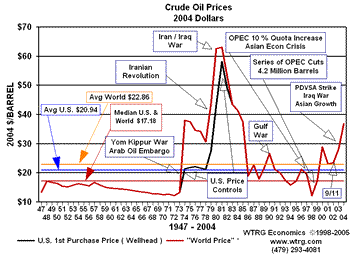
Oil prices climbed to their highest level ever, reaching over $140 per barrel this week. An analysis released by the investment firm Goldman Sachs suggested that oil prices might soar to $200 per barrel.
Does this make sense? Some say it is because the Opec cartel is unwilling to boost its supply levels. Others say it is because of fears about supplies from other countries such as Nigeria and Venezuela.
Now we have the Saudi oil summit this weekend and Saudi Arabia took 1.5M barrels a day off-line since July of ‘05 in a series of cuts and is currently producing just over 8Mbd out of their estimated 10.5Mbd maximum capacity. It is forecast by the EIA that next year OPEC alone will have over 3Mbd of spare capacity so this would be a terrible time for global demand to take a nose dive or there are going to be a lot of idle wells… Should global demand drop another 5% in the next 12 months, we could be looking at 8Mbd less demand than there was just a year ago.
As the London Telegraph points out, not only does OPEC have a current production surplus of 2M barrels a day but that surplus will rise to 3.5M barrels a day BY NEXT YEAR. Also, non-OPEC production is rising fast with a 1.5Mb gain in non-OPEC production coming down the pike next year. …Iraq, by the way, is no longer included as OPEC or non-OPEC production, a very clever way to hide 2.4 million barrels of production by the energy apologists.
There’s no shortage, no scarcity. (Not yet, at least) In fact, oil is being deliberately kept off the market to keep prices high. Consider this: if supply isn’t keeping up with demand then why aren’t there any lines at the gas stations like there were during the ’70s?
Here’s what Saudi Arabia’s King Abdullah’s said on Sunday: “Among other factors behind this unjust increase in oil prices is the abhorrent acts of speculators seeking to undermine the market.” That’s why he called the meeting to begin with. The King insists that “speculators” have played a key role.” (AFP)
How about Kuwait?
The Kuwaiti Oil Minister Mohammed al-Olaim insisted that “there is enough oil to supply the market. . . . We believe that the market is in equilibrium. The price is disconnected from fundamentals. It is not a problem of supply. Why would you have a supply problem WHEN DEMAND IS GOING DOWN.” (AP)
What about Libya?
“We believe speculation has its impact,” the OPEC chief said. Libya may reduce its oil production because THERE IS MORE THAN ENOUGH OIL ON THE MARKET Oil Minister Shokri Ghanem said. “We may have to cut production…. We don’t see any need for more oil. There is plenty of oil in the market,” Ghanem said, commenting on Saudi Arabia’s decision. (Bloomberg News)
Saudi Arabia has increased oil production by 300,000 barrels a day in May, and a Saudi official confirmed another increase of 200,000 in July, making the total output to 9.7 million barrels a day to fill the demand needs. At a recent summit in Saudi Arabia between oil-producing and oil-consuming nations, Saudi King Abdullah said his country was not to blame for soaring oil prices.
Watch the clip.
The World oil production was up 2.5 percent in the first quarter of 2008 over the same period in 2007 while world oil consumption rose by just 2 percent. In fact, world production is projected to be 3.3 percent higher in the second quarter and 4.1 percent higher in the third quarter than the same periods a year ago. On the other hand, world demand is projected to rise by just 1.6 percent over the next six months.
In fact, demand is falling in some countries. According to economist John Kemp at the commodities firm Sempra Metals, the U.S. consumed 4 percent less petroleum in January 2008 than it did the year before. Evans agrees, noting that the U.S. demand for petroleum products began falling off last July. Interestingly, this drop in U.S. oil consumption began before crude prices turned vertical and before we began to see weakness in the broader economy. Even China's thirst for oil is abating somewhat. Its demand for oil, which once rose at 10 percent per year, has now dropped to 6 percent per year. In addition, world surplus oil production capacity has gone from a very tight 1.5 million barrels per day a couple of years ago to more than 3 million barrels today, says petroleum economist Michael Lynch.
So supply is up; relative demand is down and yet, the price of oil is soaring. What's going on? Last week, Exxon Mobil CEO Rex Tillerson blamed a third of the recent run up in oil prices on the weak dollar, another third on geopolitical uncertainty, and the rest on market speculation.
Let's start with geopolitical uncertainties. Last year, oil consumers watched warily as unrest in Nigeria's oil fields, the possibility of war between the U.S. and Iran, and the antics of Venezuela's Hugo Chavez threatened to disrupt oil supplies. That analysis may have once made sense, but most of those tensions have abated in recent months. Nevertheless, it remains true that most of the world's oil is produced in volatile regions and by erratic governments, so the price of crude must still include some kind of political risk premium.
What effect does the falling dollar have on the price of crude? Most oil price contracts are denominated in dollars. The dollar has fallen in value by more than 30 percent against a Federal Reserve index of major currencies since 2002. This means that the price of imports, including oil, have gone up. To some extent, the chief of the Organization of Petroleum Exporting Countries (OPEC) Chakib Khelil was correct when he said earlier this week, "What's happening in the oil market is due to the mismanagement of the U.S. economy." Continuing U.S. trade and fiscal deficits along with lower interest rates are stoking inflationary fears.
That brings us to speculation. Evans observes that since September 2003, the total number of open crude oil futures and options contracts rose by 364 percent. Meanwhile the global demand for petroleum rose by just 8.2 percent. "So the futures and options market has become more important than the physical supplies in driving the price," concludes Evans. "We are seeing investment flows into the oil market that don't have anything to do with the demand and supply of oil."
Investors are treating oil as a hedge against inflation and a falling dollar. Oil markets are part of a positive feedback loop in which higher oil prices contribute to higher inflation, which in turn lowers the value of the dollar, which boosts oil prices, and so forth. In other words, the oil market is coming to resemble the gold market (which has also been soaring). Evans notes that most gold traders don't even ask the question of how much gold was mined last year or how much spare gold mining capacity there is.
The price of crude oil today is not made according to any traditional relation of supply to demand. It’s controlled by an elaborate financial market system as well as by the four major Anglo-American oil companies. As much as 60% of today’s crude oil price is pure speculation driven by large trader banks and hedge funds.
The crucial role of the international oil exchanges in London and New York is crucial to the game. Nymex in New York and the ICE Futures in London today control global benchmark oil prices which in turn set most of the freely traded oil cargo. They do so via oil futures contracts on two grades of crude oil—West Texas Intermediate and North Sea Brent.
A third rather new oil exchange, the Dubai Mercantile Exchange (DME), trading Dubai crude, is more or less a daughter of Nymex, with Nymex President, James Newsome, sitting on the board of DME and most key personnel British or American citizens.
Brent is used in spot and long-term contracts to value as much of crude oil produced in global oil markets each day. The Brent price is published by a private oil industry publication, Platt’s. Major oil producers including Russia and Nigeria use Brent as a benchmark for pricing the crude they produce. Brent is a key crude blend for the European market and, to some extent, for Asia.
All this is well and official.
But how today’s oil prices are really determined is done by a process so opaque only a handful of major oil trading banks such as Goldman Sachs or Morgan Stanley have any idea who is buying and who selling oil futures or derivative contracts that set physical oil prices in this strange new world of “paper oil.”
With the development of unregulated international derivatives trading in oil futures over the past decade or more, the way has opened for the present speculative bubble in oil prices.
Since the advent of oil futures trading and the two major London and New York oil futures contracts, control of oil prices has left OPEC and gone to Wall Street.
The large purchases of crude oil futures contracts by speculators have, in effect, created an additional demand for oil, driving up the price of oil for future delivery in the same manner that additional demand for contracts for the delivery of a physical barrel today drives up the price for oil on the spot market. As far as the market is concerned, the demand for a barrel of oil that results from the purchase of a futures contract by a speculator is just as real as the demand for a barrel that results from the purchase of a futures contract by a refiner or other user of petroleum.
Perhaps 60% of oil prices today pure speculation
Goldman Sachs and Morgan Stanley today are the two leading energy trading firms in the United States. Citigroup and JP Morgan Chase are major players and fund numerous hedge funds as well who speculate.
In June 2006, oil traded in futures markets at some $60 a barrel and the Senate investigation estimated that some $25 of that was due to pure financial speculation. One analyst estimated in August 2005 that US oil inventory levels suggested WTI crude prices should be around $25 a barrel, and not $60.
That would mean today that at least $50 to $60 or more of today’s $115 a barrel price is due to pure hedge fund and financial institution speculation. However, given the unchanged equilibrium in global oil supply and demand over recent months amid the explosive rise in oil futures prices traded on Nymex and ICE exchanges in New York and London it is more likely that as much as 60% of the today oil price is pure speculation. No one knows officially except the tiny handful of energy trading banks in New York and London and they certainly aren’t talking.
By purchasing large numbers of futures contracts, and thereby pushing up futures prices to even higher levels than current prices, speculators have provided a financial incentive for oil companies to buy even more oil and place it in storage. A refiner will purchase extra oil today, even if it costs $115 per barrel, if the futures price is even higher.
As a result, over the past two years crude oil inventories have been steadily growing, resulting in US crude oil inventories that are now higher than at any time in the previous eight years. The large influx of speculative investment into oil futures has led to a situation where we have both high supplies of crude oil and high crude oil prices.
Compelling evidence also suggests that the oft-cited geopolitical, economic, and natural factors do not explain the recent rise in energy prices can be seen in the actual data on crude oil supply and demand. Although demand has significantly increased over the past few years, so have supplies.
Over the past couple of years global crude oil production has increased along with the increases in demand; in fact, during this period global supplies have exceeded demand, according to the US Department of Energy. The US Department of Energy’s Energy Information Administration (EIA) recently forecast that in the next few years global surplus production capacity will continue to grow to between 3 and 5 million barrels per day by 2010, thereby “substantially thickening the surplus capacity cushion.”
Dollar and oil link
A common speculation strategy amid a declining USA economy and a falling US dollar is for speculators and ordinary investment funds desperate for more profitable investments amid the US securitization disaster, to take futures positions selling the dollar “short” and oil “long.”
For huge US or EU pension funds or banks desperate to get profits following the collapse in earnings since August 2007 and the US real estate crisis, oil is one of the best ways to get huge speculative gains. The backdrop that supports the current oil price bubble is continued unrest in the Middle East, in Sudan, in Venezuela and Pakistan and firm oil demand in China and most of the world outside the US. Speculators trade on rumor, not fact.
In turn, once major oil companies and refiners in North America and EU countries begin to hoard oil, supplies appear even tighter lending background support to present prices.
Because the over-the-counter (OTC) and London ICE Futures energy markets are unregulated, there are no precise or reliable figures as to the total dollar value of recent spending on investments in energy commodities, but the estimates are consistently in the range of tens of billions of dollars.
The increased speculative interest in commodities is also seen in the increasing popularity of commodity index funds, which are funds whose price is tied to the price of a basket of various commodity futures. Goldman Sachs estimates that pension funds and mutual funds have invested a total of approximately $85 billion in commodity index funds, and that investments in its own index, the Goldman Sachs Commodity Index (GSCI), has tripled over the past few years.
Because it’s all a fabrication. Prices are up because of speculation, that’s all