Monday, April 6, 2009

Motorola drops bomb fuse unit following boycott campaign

Motorola has sold a controversial unit that produced bomb fuses and other equipment for the Israeli military, according to the Israeli financial newspaper Globes. The sale rids Motorola of some activities that had made it the target of a growing boycott in the US and worldwide. No explanation was offered in the media reports for the sale by Motorola Israel -- a wholly owned subsidiary of Motorola -- of its unit called Government Electronics Department (GED) to the Israeli company Aeronautics Defense Systems Ltd.

The sale came just days after a 30 March protest in Brooklyn by The New York Campaign for the Boycott of Israel (NYCBI) kicking off a city-wide campaign to boycott Motorola over its support for Israeli apartheid. Ryvka Bar Zohar from NYCBI commented,

"We are heartened that Motorola has eliminated at least its production of bomb fuses for bombs that Israel dropped on the Palestinian and Lebanese people. But we will continue our campaign to boycott Motorola until it is clear that it has eliminated production and sale of all products used to support Israeli apartheid."
Human rights advocates in Boston and California also recently protested against Motorola. These campaigns build on the national "Hang Up on Motorola" campaign initiated by the US Campaign to End the Israeli Occupation, as well as initiatives by the Presbyterian and Methodist churches. University students have also recently taken up the call to boycott Motorola, achieving a divestment success at Hampshire College. Previously, Motorola had been the target of a successful boycott campaign for its support of the government of apartheid South Africa.

Motorola Israel produced fuses used in cluster, "bunker-buster," and other bombs. Cluster bombs are specifically condemned by an international consensus of human rights organizations, and banned by many countries. The US government has voiced concern over the use of these bombs and recently took steps towards a complete ban on their use. Human Rights Watch researchers reported that they found Motorola parts at the site of the bombing that began Israel's latest assault on Gaza that killed around 1,400 Palestinians, more than 400 of whom were children.

Read further here.

Sunday, April 5, 2009

The 21st Arab League Summit - A Summit of Egos.

The 21st Arab League summit held this week in Doha, Qatar ended up being little more than a summit of egos.

Sudanese President Omar al-Bashir – just indicted for war crimes in Darfur by the International Criminal Court (ICC) – arrived to a red-carpet and hero’s welcome; Egyptian President Hosni Mubarak boycotted the entire gathering; Libyan President Muammar Qaddafi walked out during the opening session; King Abdullah II of Jordan left early, apparently for not having been greeted by the Emir of Qatar but by another member of the royal family; and Hamas was not even invited. Having accomplished little, the summit adjourned one day early.

Overshadowing the gathering of Arab leaders and the League’s stated agenda of ‘reconciliation’ between the decidedly pro-American, anti-Iranian camp of nations (represented by Egypt, Jordan and Saudi Arabia) and those more willing to recognize Iran as an important regional power (namely Syria and Qatar), was the presence of al-Bashir.

In embracing al-Bashir and “rejecting” his indictment, the Arab League thumbed their noses at the West and the ICC, who called for his arrest but ignored the war crimes committed by Israel in Gaza. It may have been an understandable move by the League (which no doubt involved a bit of collective self-preservation), but certainly was not good public relations.

Next, attention was focused on the volatile and unpredictable Libyan leader. In the morning session, he railed against Saudi King Abdullah who he said was “made by Britain and protected by the United States.” The truth in those words were quickly lost however, when he went on to declare, “I am an international leader, the dean of the Arab rulers, the king of kings of Africa and the imam of Muslims, and my international status does not allow me to descend to a lower level.” He then stormed out of the hall.

Hosni Mubarak of Egypt chose not to attend the summit altogether, the second year in a row he has snubbed it. His reasons were juvenile and partially borne out of jealousy for Qatar upstaging Egypt’s traditional role as powerbroker in the Arab world and mediator of its internal disputes. It was after all the emir of Qatar, Sheikh Hamad Ibn Khalifa al-Thani, who brokered the agreement last year between Lebanon’s March 8 Coalition (Hezbollah, Amal, and the Free Patriotic Movement) and the ruling March 14 Alliance, resulting in an equitable allocation of cabinet seats, eventual election of President Michel Suleiman and an end to the long standoff.

The Emir also convened an emergency Arab summit in Doha during Israel’s assault on Gaza earlier this year, and helped with reconciliation efforts between Hamas and Fatah (and between King Abdullah and Qaddafi during the summit). His backing of Hamas in the Gaza war was another reason Mubarak kept well clear of Doha.

It was Sheikh Ibn Khalifa al-Thani who appeared to have made the most cogent and germane remarks, warning of the potential catastrophic effects the global economic crisis may have on the Middle East, stating, “… the Arab world is in the direction of the wind and the eye of the storm.”

With looming economic concerns, the brouhaha over al-Bashir’s presence, and some notable absences (the kings of Morocco and Bahrain also did not attend); little if any time was spent on the fallout from Israel’s barbaric attack on Gaza. Other than to reiterate the League’s endorsement of the 2002 Saudi Peace Plan calling for full recognition of Israel in exchange for a complete Israeli withdrawal to pre-1967 borders, the League’s position appeared stagnant at a dynamic time.

After an inhumane embargo which had deprived Gaza of basic humanitarian supplies and necessities, the use of white phosphorus against civilians by the Israel Defense Forces, and countless reports of the deliberate targeting of innocent men, women and children (first by Palestinian eyewitnesses, then verified by humanitarian agencies and now confirmed by Israeli soldiers), the Arab League was mute.

To prevent other leaders from boycotting the summit, the remarkable decision of not extending an invitation to Hamas – the democratically-elected Palestinian government –was made. In the meantime, Israeli annexation of Palestinian territory and demolition of homes continues unabated under the new leadership of a right-wing prime minister, a fascist foreign minister and a coalition of extremist religious parties.

Not only did the Arab heads of state fail to heal their deep rifts, they did not tackle the thorny issue of relations with Iran or even begin to address the ramifications an increasingly likely Israeli attack will have on the region. Instead, egos, petty disputes, red-carpet welcomes and diplomatic snubs held sway.

Once again, ordinary citizens of the Middle East this week were reminded why the Arab League has become an utterly irrelevant, feckless institution.

Article taken from here.

Could Bush Be Next?

Saturday, April 4, 2009

Any Movie About Palestinian Massacre?

Thursday, April 2, 2009

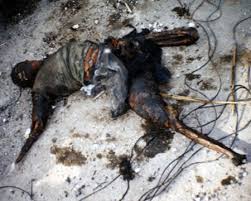
Report excoriates Israel's use of white phosphorous in Gaza

Fred Abrahams, senior emergencies researcher for HRW, said in a press conference in Jerusalem last Thursday that the evidence suggests the Israeli military intentionally used white phosphorus in Gaza for its incendiary properties.

"To us, the evidence suggests that the purpose in some of these cases may have been not to create a smokescreen, but to use white phosphorus specifically for its incendiary effect. Do we know that for sure? No, we don't. But, the evidence is suggestive that they used it for incendiary purposes," Abrahams told journalists.

The HRW report states that "the repeated use of air-burst white phosphorus in populated areas ... reveals a pattern or policy of conduct rather than incidental or accidental usage." These circumstances demand independent investigation, HRW says, and -- if warranted -- the prosecution of all those responsible for war crimes.

"The Israeli military and government is repeatedly blaming Hamas for civilian deaths in Gaza. Now, do we have something to say about Hamas' behavior in Gaza? Yes, we do ... This is the first in a series of reports we will be issuing. Its rocket attacks in Israel ... are a war crime. In the cases of this report ... we did not find evidence of Hamas using civilians as human shields. Now, were they in the area at the time of these attacks? In some cases, we believe they were, and that is documented in the report. We state very clearly where we believe Hamas was, and where it was not. The bottom line, and the crucial point, is even if enemy forces -- from the Israeli perspective, Hamas fighters -- are in the area, white phosphorus should not be used in civilian neighborhoods. And that's the bottom line," Abrahams stated.

The Israeli military issued a statement after the release of HRW report, saying that it was nearing the completion of its own investigation. In the statement, the military claims that its use of white phosphorus had been fully consistent with international humanitarian law.

But, Abrahams said, this shows that Israel has already drawn its conclusions before the investigation was finished. The Israeli military "at first denied repeatedly that white phosphorous was being used. Publicly and to the media, they denied that it was being used. Then, faced with incontrovertible evidence, photographs, that white phosphorus was being used, they back-tracked, and they said, well all the weapons that we use in Gaza are in compliance with international humanitarian law. And now, they tell us that they're opening an investigation. Well, quite frankly, we have a hard time accepting that at face value."

Abrahams also said that Israel "refused to give any details about the investigation, and these are the questions we want answered about the investigation: who's leading it? When will it be completed? What is the scope of the investigation? And, will its findings be made public? We don't have answers to any of those questions ... But, in fact, it doesn't matter. It doesn't even matter, because the statement yesterday concluded that the investigation already determined that the white phosphorus use was 'consistent with international humanitarian law.' So the findings have already been made public."

Moreover, HRW researchers are still denied access into Gaza through Israeli border crossings, Abrahams said, "and we can only conclude that this in an attempt to prevent us from conducting our investigations."

According to Abrahams;

"In our view, the Israeli military has been infected by a climate of impunity, going back over since 2005, the disengagement [Israel's unilateral withdrawal from Gaza]. There is an attitude that soldiers can do what and how they want in Gaza, and this has had a direct impact on civilian lives. It has caused civilians to die. That's because soldiers believe they can get away with what they want -- no one is watching. And that's why investigations are so important, to break this climate of impunity."
Read the 71-pages-long Human Rights Watch (HRW) report, entitled "Rain of Fire: Israel's Unlawful Use of White Phosphorous in Gaza".

Article taken from here.